Global Urban and city development trends A.D. 2025
Based on the analysis of the City+2025@Oxford conference presented newest research
Dr. Fred C. Sanders, MSc MBA, Senior Fellow and director of CPONH NGO for EU research.
Dr. Yongping Zhang, Ass. Professor, School of Public Affairs, Zhejiang Un., Hanghzou, China.
Summary
The City+2025@Oxford conference gave many insights into the themes and topics that are relevant for city and urban development in the coming centuries, especially considering polycrisis (e.g., geopolitical tensions and climate change) are now becoming more influential. Connecting the West and the Eastern world of our planet, connecting old knowledge of different cultures too, can become remarkably strong knowledge of importance for making the step to resilience. The central conclusion of the presentations, as analysed, is: resilience can be found in old knowledge and in complex analyses of new knowledge as long as we combine these to make cities and the citizens stronger.
1. Introduction
City+ is an international association on interdisciplinary urban studies. Its core members come from some world or Asia-leading universities such as University of Cambridge, Chengchi University, University College London, Delft University of Technology, University of Hong Kong, Polytechnic University of Milan, Tongji University, University of Oxford, and Zhejiang University. Recent years it has organised eight annual international conferences in the UK, the Netherlands, Italy, Australia, and Japan, covering the themes of urban planning and design, smart cities and geographic artificial intelligence, urban development and governance, and future environmental city development.
Therewith City+ is a potential platform for sharing research experiences and thinking, developing cooperation opportunities, and addressing urban concerns from an interdisciplinary perspective, for leading experts, policymakers, researchers, and industry practitioners, and for young researchers during their PhD stage in special. More than one thousand delegates from many leading universities and institutes across countries from all continents have participated in these conferences.
With participation from European and Asian countries, and a growing number of attendees, researchers as it turns out every year, that work closely at the forefront of interdisciplinary urban studies, the annual City+ conference can also be seen as an annual update on the latest trends of research in urban development in the context of its regional landscape. Therewith it becomes interesting to analyse the themes and topics introduced, as a signal function for research and cities in development, which new developments deserve attention. To explore this, the presentations at the City+2025@Oxford conference were analysed at two levels: the themes presented and, for each, the topics discussed as relevant. This is of course within the framework of the research field adopted by City+.
This is thanks to the many participants in the 2025 conference, which was organised by the School of Geography and the Environment, University of Oxford. City+2025@Oxford concluded with great success, bringing together over 175 attendees coming from 96 universities and institutes across 23 countries/regions. The conference featured a rich and diverse programme, including 138 presentations, 1 plenary panel discussion, 3 plenary keynotes, and 4 workshops.
The inviting theme of the conference chosen was: “Urban Data Analytics and the Polycrisis”, because the world’s cities are increasingly at the forefront of a complex and interconnected web of challenges; known as the polycrisis. These are, as given by the conference organising team: climate change, economic instability, rapid urbanisation, public health crises, and geopolitical tensions.
This conference delved with this invitation extra into the pivotal role of data analytics in addressing interconnected crises, equipping attendees with the skills to effectively manage and utilise data, to challenge even the busiest researchers to contribute, because with the power of big data, machine learning, and predictive modelling, we can uncover patterns, assess risks, and develop informed strategies more than before.
Successively, the data and analysis of the themes and topics given to these themes by the presenting researchers during the conference, all related to city development and urban vulnerability, will be presented in chapters 3 and 4, after that the conference was placed in the field of conferences, see therefore chapter 2.
2. The City+ conference in the field of conferences
Sustainable and liveable cities; many conferences are devoted to these themes annually, both small-scale and local, primarily at universities, and on a global scale through organisations to which universities are affiliated, as well as by global organisations such as the United Nations.
Because most of these conferences are organised annually, an overview of the conferences held in 2025 will suffice before comparing them with the City+2025@Oxford conference. The inventory is categorised according to the three aforementioned scales: global scale, the scale of combined co-organisers, and repeated initiatives by universities or comparable scientific institutions, see Table 1.
This overview of conferences on the themes mentioned is, of course, not exhaustive, especially when it comes to small-scale conferences, many of which will have taken place in 2025. But searching the internet using various keyword searches, like: city, development, climate change, liveability, and adaptation, these ones that come up out of the inventory.
When analysing the themes discussed during the conferences from this inventory, two qualifications can be mentioned in particular. Firstly, there’s a kind of split: at the major world congresses, particularly those of the United Nations, climate change is discussed without substantively touching upon the practicalities of cities and landscapes. It remains a reflection, more a call for urgency than perspectives for action, while the smaller congresses remain practical and primarily focused on the here and now. In particular, the intermediate-level conferences, generally organised by continental institutions such as AESOP, ISUF, and AMPS in Europe, Asia, and North America, pay noticeably more attention to strategic options, connecting climate change and other global developments, for example, geopolitics to urban life in all its gradations.
Table 1, overview of 2025 conferences regarding the city, sustainability and liveability
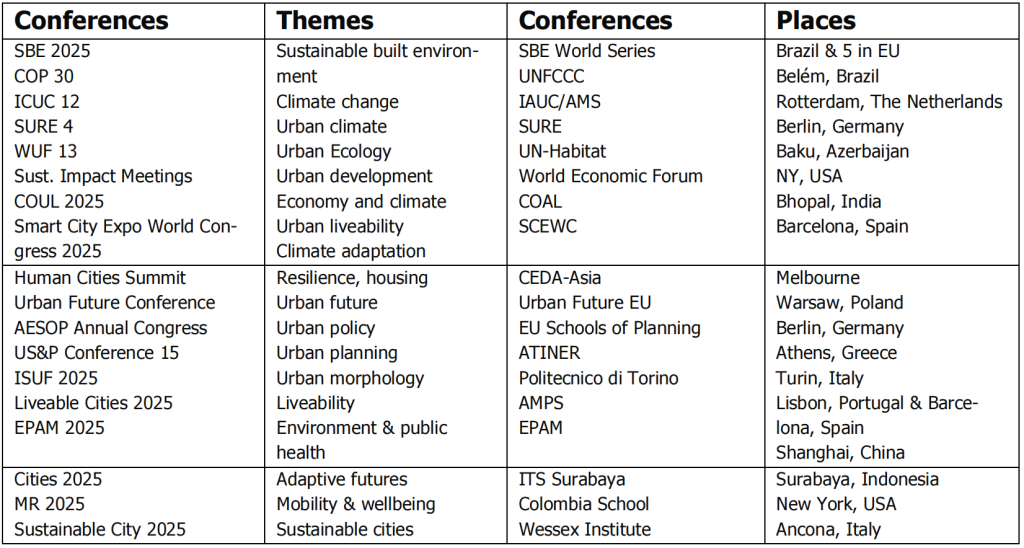
These conferences thus create a challenging connection between the major changes in our world, with people’s daily lives, their housing, work, mobility and health and many aspects of life that are connected to this. It can be seen that the City+ conference, as it has been organised for a number of years now, is connected to this scale, and looking at the themes over the years (city development, city design, smart urban life, geospatial data and AI, future for environmental city). It has also succeeded in connecting that large scale of developments that we cannot influence individually on the human scale and often cannot even grasp, to the essentials of our daily lives. What’s interesting and distinctive about the City+ conferences is that participants facilitate an exchange of knowledge and insights between the situation in Europe and Asia, between the Western and Eastern worlds. Precisely because these are both highly developed and scientifically relevant worlds, this provides the opportunity, with the knowledge that the scale of the City+ conferences is relevant because the strategic development component is discussed, to explore in more depth which current themes will be of importance in 2025, regarding climate change and other global influences on urban life. Please see the following chapters for an analysis of the themes and related topics based on the latest City+2025@Oxford conference.
3. The presented themes of City+2025@Oxford
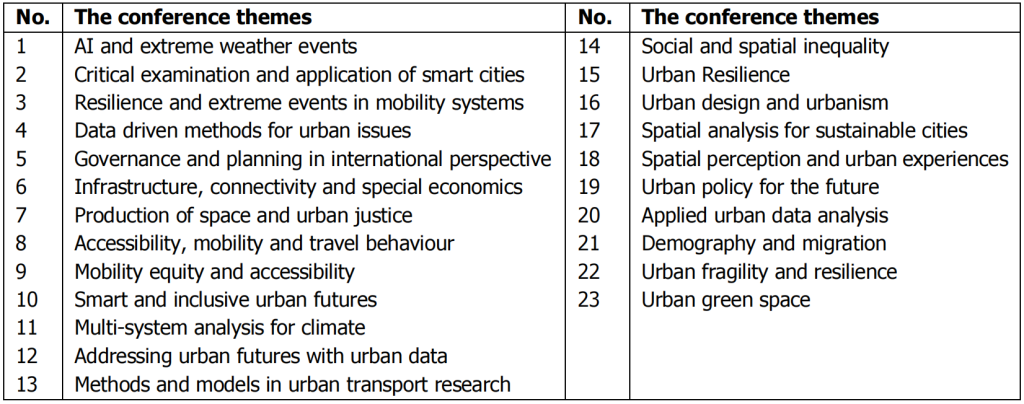
In total, the submitted and peer-reviewed presentations for the City+2025@Oxford conference were categorised under 23 themes, which concern great global changes influencing the life and liveability of people in cities with climate change in special. Interests should be which other influencing global changes were suggested and which themes were future-oriented, not only discussing the past or actual situations, but giving a sketch of a possible future based on data analysis. For the themes see Table 2.
Table 2, Themes of the parallel sessions of the City+2025@Oxford conference.
The comparison and classification were carried out by placing the themes in a quadrant, with climate change on the horizontal axis, from absent in the theme to main in it, with a vertical axis concerning future orientation building up from absent in the theme to strongly present. The result showed that many themes, 13 out of 23, roughly half of the total, were not specifically about climate change and resilience or major developments for the future of urban populations. While these 13 themes should be interesting topics, such as ‘spatial inequity’ (14) and ‘green space’ (23), the 10 themes concerning climate change, resilience and future-oriented, concerning climate change and future orientation, particularly tie in with the challenge of the inviting conference title, see Figure 1.
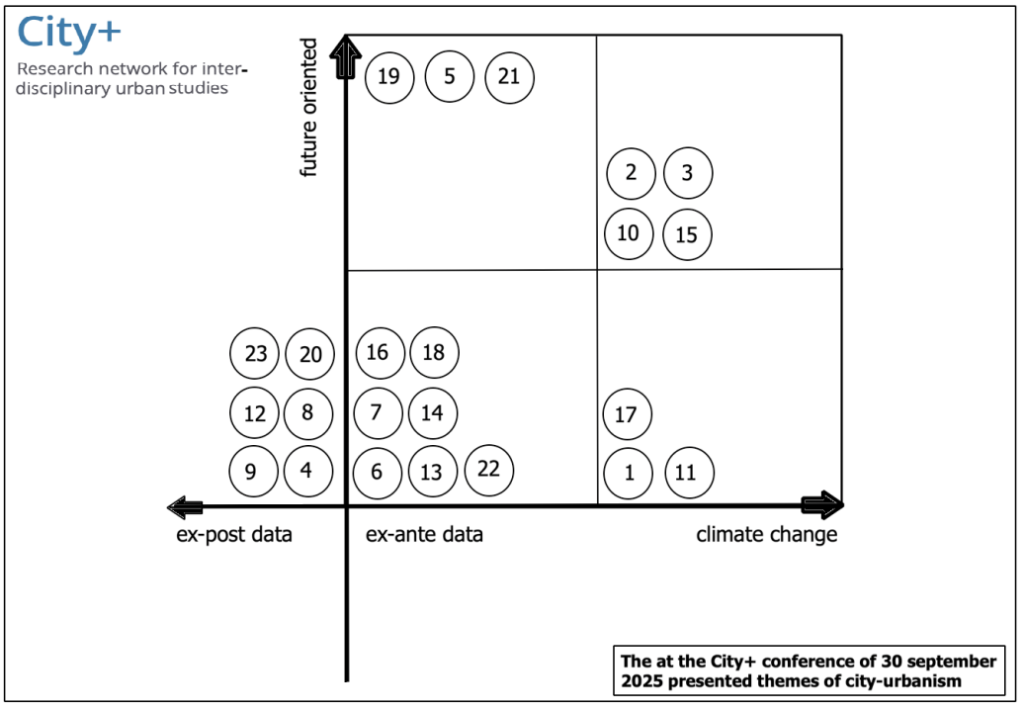
Figure 1, Classification of the City+ congress themes, climate change versus future-oriented.
Note: This classification provides a clearer distinction between the basic themes and the more clearly future-oriented themes. Where it is noticeable that most of the basic themes concern mobility and transport issues, concern the lack or use of inner-city space and themes such as social inequity and fragility.
The underlying message seems to be that our cities are becoming increasingly crowded, every bit of space is under pressure to be used, for housing construction and the associated increasing need for mobility, with almost no room left for meeting places and green space for relaxation of the people and the preservation of biodiversity. The increasing crowding can also increase disparities among the citizens, as mentioned in these conference themes, in access to amenities and people’s living standards, thereby putting pressure on the safety of people, especially women. These are the most important basic themes, the current challenges in the world’s cities, if we are to follow the invitation to the City+ conference and the clustering of the submitted scientific papers.
The themes related to climate change and future-oriented developments can follow the information of Figure 1, be divided into three groups of themes: future-oriented, because of climate change and resilience and smart cities being also a more or less combination of the former two. A striking new topic falling under future development is migration (21), which, in addition to the two other general orientation themes. Less surprising but nevertheless distinctive are the themes linked to climate change, extreme weather conditions (1) and also in relation to land use (17). In between, the themes that are both future oriented en climate change-related show to be the themes of smart cities (2) (10) and resilience (3) (5). But in general, all the future-oriented and climate change-related themes are noticeably less specific, less tangible, and that makes it extra interesting to delve deeper into the topics of the submitted papers, see Chapter 4.
4. The conference presented topics with the themes
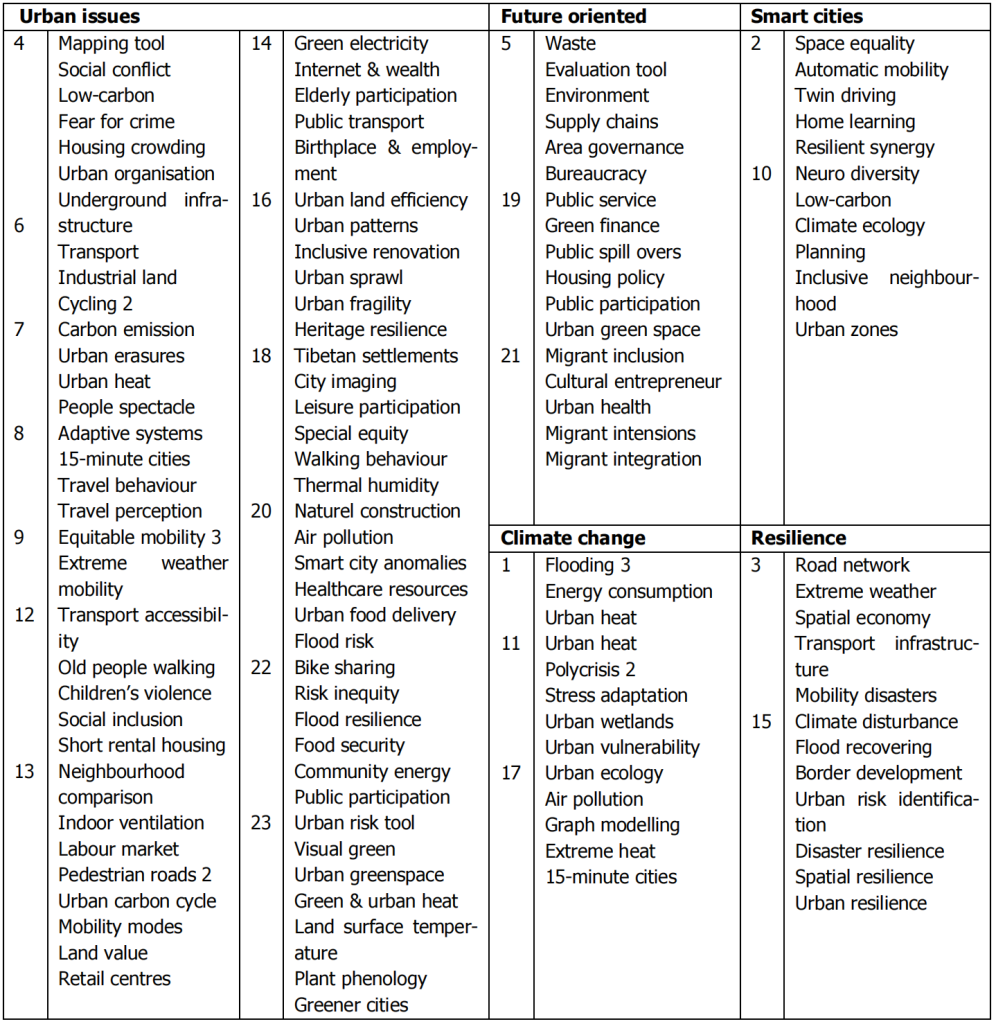
To better understand the topics presented during the City+2025@Oxford conference, the most important keywords have been listed for each of the 23 parallel sessions, see attachment table 4, separately per cluster of sessions as presented in chapter 3, and placed in the order in which these keywords appeared, see Table 3. The result is that for “urban issues,” the wide variety of 25 keywords proves necessary to adequately characterise all the contributions from the 13 sessions. For the four labelled sessions (future oriented, smart cities, climate change nans resilience) 11, 6, 7 and 5 keywords were identified respectively to categorise the substantive contributions.
In retrospect, the small number of 6 of the total 73 presentations could have been more logically classified differently; these are listed separately in the table. On the other hand, six presentations presented during the other sessions, earmarked under the other four classifications, could have been more appropriately placed under the sessions classified as “urban issues.” Both shifts were, of course, taken into account in the analysis.
Table 3, topics ordered with the presentations of each of the 23 themes.
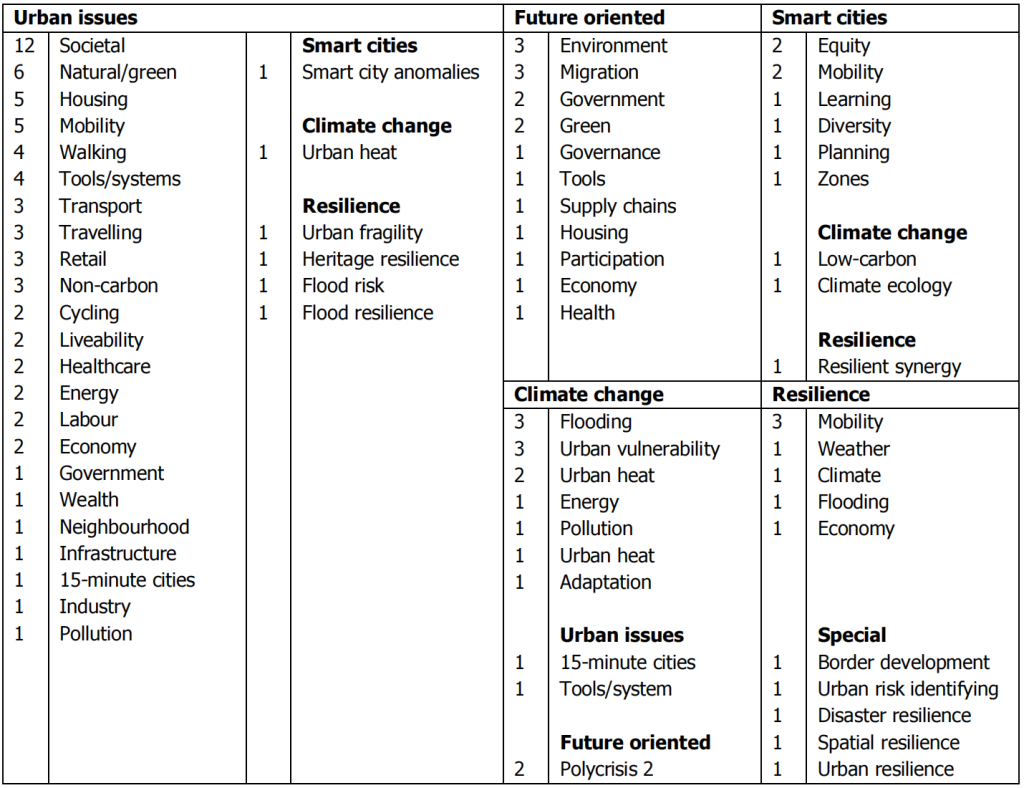
Analysing the results, it can be concluded that for cities in general (urban issues), basic amenities remain important: a positive social and societal context, good housing, and opportunities for mobility, exercise, and travel. It’s also notable that the “polycrisis,” the theme of the conference, received few presentations focus. Remarkably, “green spaces in the city” receive much more attention than energy. This seems to be a trend reversal.
The themes “future-oriented, smart cities and climate change” show more remarkable keywords, which can thus be seen as new topics for monitoring sustainable urban development. These distinctive topics are: migration and green, equity and urban vulnerability. Regarding resilience, however, many new topics were presented, and almost every presentation offered a different perspective. Therefore, these will be addressed in more detail in Chapter 5, and the presentations themselves will be discussed in more detail.
5. Resilience defined in a polycrisis
In a polycrisis, ‘resilience’ is not to be ‘one-dimensional’ only, as argued by the first presentation of the ‘resilience session’ by the researchers from Chinese origin (Yang Yang et al 2025). A ‘pro-active risk management framework’ is necessary to address all the vulnerabilities of a city in its complete existence. They studied numerous flooding hazards of the southern USA and came to the conclusion to mitigate the escalating damages and to integrate long-term resilience strategies into disaster planning, to avoid numerous losses of real estate property and its investments in the future. A conclusion like this was confirmed by studying the development of countless coastal zones as carried out by the Sino-Belgian team (Zhang et al 2025). They concluded with their own words, that context-specific models are necessary to integrate multiple drivers and local frontier characteristics to define appropriate pathways for future growth of resilience. As well as a totally different study on criminal burglaries and violence against women (Liu 2025) proves, that context-sensitive, hybrid methodologies could only produce advanced resilient and inclusive urban futures in an era of multiple crises. Three studies, each of which confirms that resilience requires a very broad approach, especially in uncertain times with a multitude of different influences.
The other 14 study results – the 9 of the resilient-oriented sessions (3 + 15) with the 5 with a resilient topic at the other sessions – see Figure 1 and Table 3 – presented at the City+2025@Oxford conference also confirmed this picture, but revealed something further: resilience has moved beyond the risk of flooding and the nuisance of extreme clustered downpours. In a society where people increasingly demand more from their lives, often together with others, resilience is sought across an ever-broader spectrum of necessities, as was presented: the increasing pressure on spatial use in cities and beyond, the desire to protect vulnerable heritage or to make it more important, also preserving vulnerable places because of their special value for people’s lives, this beside flooding studies on other places, and the existence of multiple parallel resilience challenges.
6. Conclusions and remarks
The City+2025@Oxford conference gave us many insights into the themes and topics that are relevant for city and urban development in the coming centuries, in special now polycrisis including geopolitical tensions and climate change are becoming more influential. Connecting the Western and the Eastern world of our planet, connecting old knowledge of different cultures too, can become remarkably strong knowledge of importance for making the step to resilience. The central conclusion of the presentations as analysed is: resilience can be found in old knowledge and in complex analyses of new knowledge as long we combine these for making cities and the citizens stronger. Thanks to this special City+ network.
And as a closing thought, one presentation during the resilience session took a reverse course; they had previously investigated natural resilience in the settlements of remote peoples in the Tibetan Highlands (Li et al 2025). The conclusion was that social cohesion and people’s memory of measures taken in the past increase resilience in the present. An interesting result with a message for all polycrisis expectations: that the solution lies not only in more future-oriented research, but that we can also learn a lot from the past. This seemingly connects traditional urban issues research and future-oriented research, a motivation to continue with both.
Literature
- Gang Deng, Rui Wang, 2025, Study on the Spatiotemporal Evolution and Driving Factors of Urban Resilience in China, City+2025@Oxford conference.
- Huanjie Liu, Pesoa Marcilla Melisa, Rui Zhang, Yukun Zhang, 2025, Disaster Resilience and Sustainable Value of the Lougang Polder System: A Spatiotemporal Analysis of Floods and Droughts in the Taihu Basin During the Ming and Qing Dynasties, City+2025@Oxford conference.
- Wanbo Liu, 2025, Imperfect but Adaptive: Spatial Analysis for Urban Risk Identification Under Data Constraints, City+2025@Oxford conference.
- Weijia Li, Pesoa Marcilla Melisa, 2025, Climate Adaptation and Spatial Resilience in Highland Settlements: A Case Study of Tibetan Tribal Systems in the Hehuang Region, City+2025@Oxford conference.
Attachment
Table 4, topics given with the presentations of each of the 23 themes.